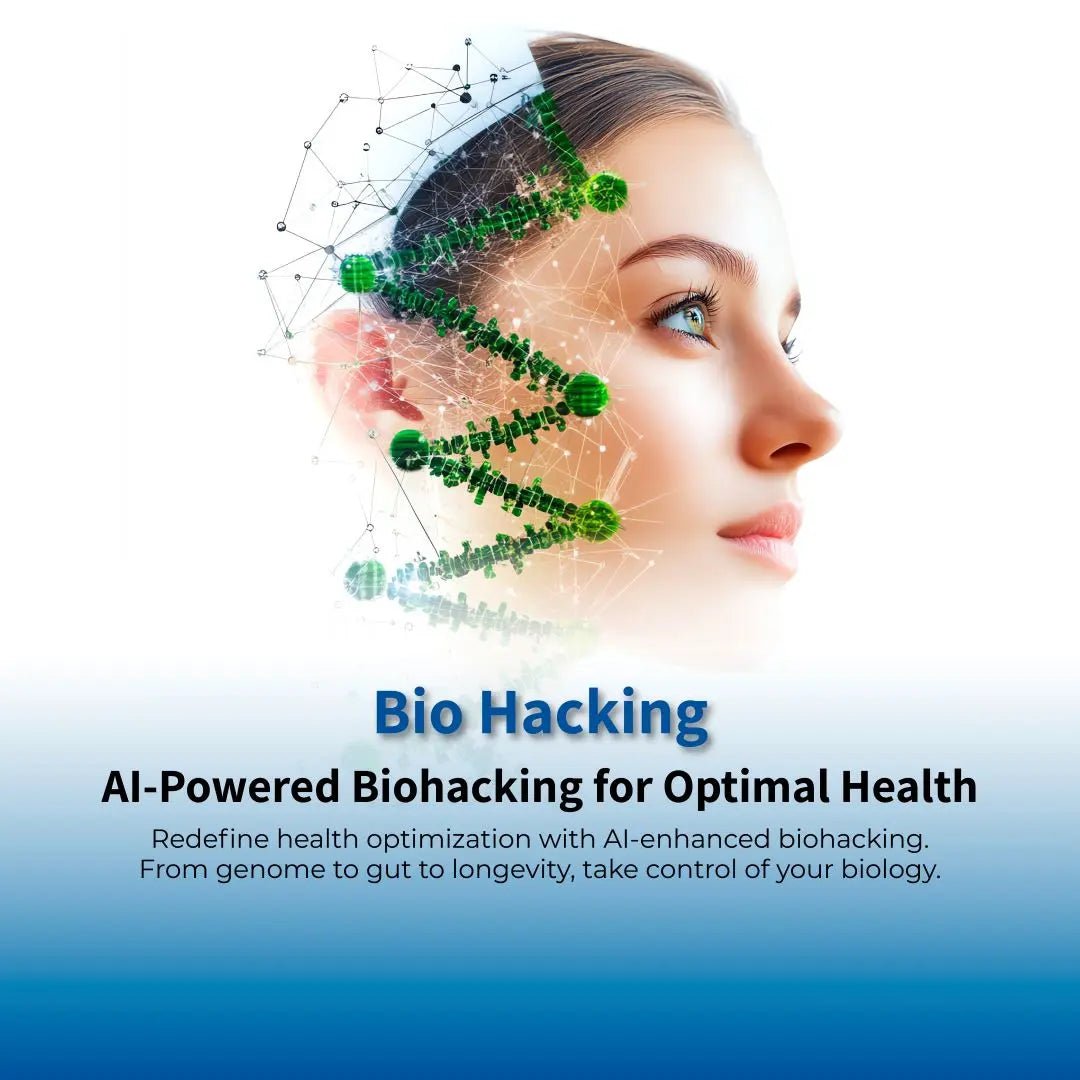


I get asked this a lot — at conferences, on panels, sometimes by my own team: "Anu, is biohacking even a real thing, or is it just wellness marketing with better branding?"
Fair question. I've spent over a decade building a genomics company on the belief that most health advice is written for a person who doesn't exist — some statistical average nobody actually is. So when "biohacking" started showing up everywhere, my first instinct was skepticism too. Ice baths, nootropic stacks, someone's morning routine turned into a religion.
But strip away the noise, and there's something underneath it I actually believe in deeply: stop guessing about your body. Start measuring it.
That's not a new idea. Doctors have wanted better data on their patients forever. What's new is that we — as individuals — finally have access to the kind of data that used to sit locked inside research labs. That shift is the whole reason I started this company in the first place.
The "Average Person" Doesn't Exist — So Why Are We Following Their Diet Plan?
Here's something that still surprises people when I explain it: two people can follow the exact same diet, the same workout plan, the same sleep schedule — and get completely different results. Not because one of them is doing it wrong. Because their biology was never the same to begin with.
Their metabolism is different. Their gut bacteria is different. The genetic hand they were dealt at birth is different. We've been prescribing one-size-fits-all health advice to a species that is, biologically, anything but one-size-fits-all.
That's the gap real biohacking is trying to close — not through hacks in the listicle sense, but through multi-omics testing: actually looking at your biology before you try to optimize it.
Your Three "-Omes" — and Why None of Them Tells the Whole Story Alone
I think about it in three layers, and I've come to appreciate that each one is answering a completely different question.
Your genome is the DNA you were born with. Fixed. Non-negotiable. It's your factory settings — how you tend to process carbs, how your body responds to specific medicines, what conditions you're genetically loaded toward, whether that's diabetes, heart disease, or something else entirely. It won't tell you what's happening in your body today. It tells you your tendencies for life.
Your epigenome is the layer that's always in motion — how your genes are being expressed right now, shaped by stress, sleep, food, the years behind you. This is the layer that can tell you your cells are aging faster, or slower, than your birth certificate suggests. It's dynamic in a way your genome never will be.
Your microbiome is the wildest card of the three — trillions of bacteria in your gut, shifting week to week with what you eat, how stressed you are, even what you took for a headache last month. It quietly runs digestion, immunity, and — research increasingly suggests — a good deal of your mood too.
Read only one of these and you're reading half a sentence. Your genome might say you're not predisposed to metabolic trouble, while your gut and your epigenetic markers are already telling a different story — one your DNA alone would never flag. Multi-omics simply means reading all three together, so you're acting on the whole picture and not a fragment of it.
Why We Test in Phases, Not Everything at Once
People sometimes ask why we don't just run every test on day one. Two reasons, and both come down to something I find genuinely elegant about how this data behaves.
First — these layers don't move at the same speed. Your genome today is your genome in twenty years. It's a one-time foundation. Your epigenome and microbiome are live feeds, responding to what you actually do differently tomorrow. Testing the moving layers before you've established the fixed one is like checking your speed before you've picked a direction.
Second — your foundational results tell you what's actually worth chasing next. Find an elevated genetic risk around heart health, say, or a sensitivity to a common medication — and suddenly you know exactly which follow-up tests matter for you, instead of running everything available and hoping something's useful.
That's why we built our Phase I: Foundational Testing the way we did — as a starting point, not a scattershot.
What's Actually in That Foundation
Strip away the marketing language, and here's what a proper foundational panel gives you:
- Whole genome sequencing — a full read of your genetic blueprint: health predispositions, ancestry and migration history, and how your body is likely to respond to a wide range of common medicines
- Proactive risk screening — hereditary and lifestyle-driven risk across cancer, diabetes, and heart disease, plus carrier and pathogenic variant analysis
- Gut microbiome analysis — a live read of your bacterial balance and what it's telling you about digestion and immunity today
- Biological age and aging metrics — how your organs and cells are actually aging, independent of what your birthday says
Together, that's not a single result. It's a baseline — the "before" everything else you do gets measured against.
A Report Isn't a Plan. That Part Matters to Me.
Here's something I say often, and I'll say it here too: the report is not the win. A page of biomarkers sitting in your inbox does nothing by itself. The value only shows up once someone — a genetic counselor, a physician — sits with you and turns "here's your data" into "here's what to do about it."
That's the line, for me, between biohacking as a buzzword and biohacking as a discipline worth taking seriously. The buzzword chases tools. The discipline runs a loop — measure, act, remeasure — and keeps running it.
Where I'd Tell You to Start
If any of this is speaking to something you've already been circling, our Ultimate Biohacking Package: Phase I Foundational Testing brings your genome, microbiome, and biological age together in one foundational report, with a genetic counselor to walk you through what it actually means for you.
It's a serious investment, and I'd rather you think of it that way than as an impulse buy. It's the baseline everything else in your health journey gets measured against — which, to me, has always been the point of doing any of this at all.
Stop Guessing. Start Measuring.
The Ultimate Biohacking Package: Phase I brings your genome, microbiome, and biological age together in one foundational report — with a certified genetic counsellor to turn the data into an actual plan. The baseline everything else gets measured against.
Explore the Ultimate Biohacking Package → Book Genetic Counselling →